


Third-party logistics, commonly known as 3PL, is when a business outsources parts of its warehousing, order processing, picking, packing and shipping to an external fulfilment provider.
For an Australian eCommerce business, that usually means your products are stored at a 3PL warehouse. When an order is placed through your online store, the warehouse team picks the products, packs the order and arranges delivery to the customer.
A good 3PL does more than store boxes and send parcels. It becomes part of your operation, helping you manage inventory, process orders consistently and build fulfilment systems that can support growth.
For many brands, moving to a 3PL is also about getting time back. Instead of managing warehouse space, packing orders and chasing carriers, the internal team can focus on products, marketing, customer relationships and growing the business.
How Does Third-Party Logistics Work for eCommerce Businesses?
A 3PL manages the physical steps that happen between receiving your stock and delivering an order to your customer.
While every operation is slightly different, the process generally works like this:
-
Receiving your inventory
Your products are delivered to the 3PL warehouse. The warehouse team receives the stock, checks it against the information you have provided and places it into the appropriate storage locations.
Accurate receiving is important because inventory issues at this stage can create problems later. Product names, SKUs, barcodes, carton quantities and incoming shipment details should all be confirmed before the stock arrives.
-
Storing your products
Once received, your products are stored until they are required for an order. Depending on the size, order frequency and quantity of each product, inventory may be stored on pallets, shelving or in smaller picking locations.
A warehouse management system records where each product is located and how much stock is available.
-
Receiving customer orders
Your eCommerce store connects with the 3PL’s warehouse management system. When a customer places an order, the order information flows into the warehouse automatically. This removes the need to email orders or manually upload information each day.
The warehouse team can then see what needs to be picked, how it should be packed and where it needs to be sent.
-
Picking and packing
The correct products are picked from their storage locations and brought to the packing area. The order is then packed according to the agreed requirements. This may include branded satchels, custom boxes, thank-you cards, protective packaging, promotional inserts or specific packing instructions for particular products.
This is why clear packaging rules should be agreed before going live. The warehouse team needs to know what matters to your brand, what requires extra protection and how different order combinations should be handled.
-
Dispatch and tracking
Once packed, the shipping label is created and the parcel is handed over to the selected carrier. Tracking information is then sent back to the eCommerce platform and communicated to the customer.
The order can be monitored throughout delivery, and any carrier delays or exceptions can be investigated when required.
-
Returns
Many 3PL providers can also receive and process customer returns. Depending on your instructions, returned products may be inspected, restocked, quarantined, returned to you or disposed of.
Returns should be treated as part of the overall fulfilment process rather than something worked out after problems arise.
The Technology Behind Third-Party Logistics
Technology connects your online store with the warehouse.
Most eCommerce 3PLs use a warehouse management system, commonly referred to as a WMS, to manage inventory, orders, picking, packing and dispatch. Platforms such as Shopify, WooCommerce and BigCommerce connect with the WMS so information moves automatically between the store and the warehouse.
For example:
- A customer places an order through your website.
- The order appears in the warehouse system.
- The warehouse team picks and packs it.
- The parcel is dispatched.
- Tracking information is sent back to your store.
- Inventory levels are updated.
Without a reliable integration, these steps may depend on spreadsheets, emails and duplicate data entry. That adds administration and increases the likelihood of orders being delayed or entered incorrectly.
At Fulfilpackers, we use Mintsoft to connect eCommerce sales channels with warehouse operations, inventory, dispatch and tracking — over 150 platforms integrate directly, so orders from multiple sales channels feed into a single fulfilment workflow without any manual data entry.
The software is important, but the process behind it matters equally. Product data, SKUs, barcodes, bundles, packaging requirements and order rules all need to be set up correctly for the integration to work as intended.

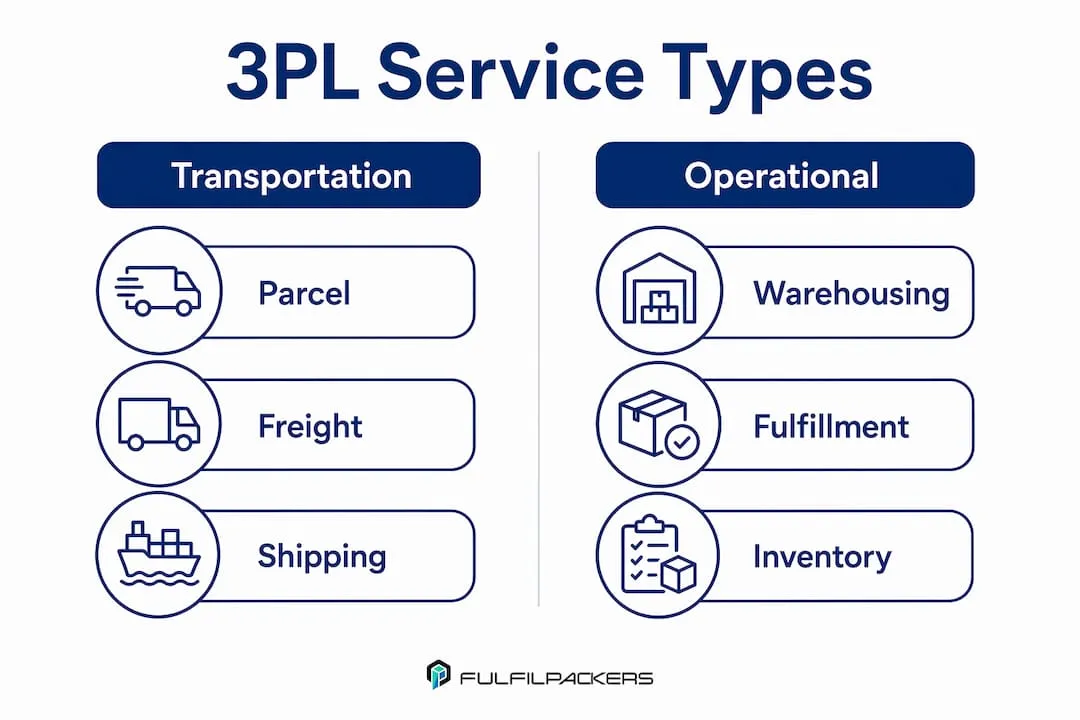
What Are the Different Types of 3PL Providers?
The term 3PL covers a wide range of logistics businesses.
Some providers focus mainly on transportation, while others manage warehousing and complete order fulfilment.
| Provider type | Main function | Common use |
|---|---|---|
| Transportation-based 3PL | Freight, parcel delivery and carrier coordination | Businesses that manage their own warehouse but need shipping support |
| Warehouse-based 3PL | Storage, inventory handling, picking, packing and dispatch | Businesses outsourcing day-to-day fulfilment |
| Specialist eCommerce 3PL | Online store integrations, B2C orders, returns, kitting and branded packaging | Growing online retailers |
| Freight-focused provider | Importing, exporting and moving stock between locations | Businesses managing local or international freight |
| 4PL provider | Coordinates multiple logistics providers and broader supply-chain strategy | Larger or more complex supply chains |
For most growing eCommerce businesses, a specialist eCommerce 3PL is the most relevant option.
These providers are set up to process individual customer orders, connect with online stores and manage the detailed packing requirements that often come with consumer products.
What Is the Difference Between a 3PL and a 4PL?
A 3PL normally carries out the physical logistics work. This may include:
- Receiving inventory
- Storing products
- Picking and packing orders
- Dispatching parcels
- Processing returns
A fourth-party logistics provider, or 4PL, usually sits above multiple logistics providers and coordinates the broader supply chain.
A 4PL may manage freight companies, warehouses and other service providers on behalf of a larger business. It often focuses more on strategy and coordination than physically handling each order.
Most small and growing eCommerce businesses need reliable fulfilment execution, which means a 3PL is generally the more suitable model.
What Are the Benefits of Using a 3PL for Australian eCommerce?
Less Time Spent on Fulfilment
Packing orders can feel manageable when volumes are low.
As the business grows, the time required to receive stock, organise inventory, pack parcels, book carriers and answer delivery questions can quickly become significant.
A 3PL takes much of that daily workload away from the internal team.
More Flexibility as Order Volumes Change
eCommerce order volumes are rarely consistent throughout the year.
Promotions, new product launches, Christmas, Black Friday and other peak periods can create sudden increases in demand.
A 3PL is designed to manage changing volumes without the business needing to find additional warehouse space or recruit temporary fulfilment staff each time orders increase.
Reduced Warehouse and Staffing Commitments
Running fulfilment internally involves more than paying someone to pack an order. There may also be costs associated with:
- Warehouse rent
- Racking and storage equipment
- Packing benches
- Warehouse software
- Insurance
- Staff recruitment and training
- Packaging storage
- Equipment maintenance
- Workplace health and safety requirements
A 3PL converts many of these fixed commitments into costs that move more closely with your storage and order activity.
Better Inventory Visibility
A warehouse management system provides visibility over stock levels, orders and inventory movements.
This makes it easier to understand what is available, what has been allocated to orders and when more stock needs to be ordered.
Good inventory visibility also reduces the risk of selling products that are no longer available.
More Consistent Order Processing
A dedicated warehouse team follows agreed processes for receiving, picking, packing and dispatch.
That consistency becomes increasingly important as order volumes grow and more people become involved in the operation.
Access to Multiple Carriers
A 3PL will generally work with several carriers rather than relying on one delivery service for every order.
Different carriers may be better suited to different locations, parcel sizes or delivery requirements.
A broader carrier network gives the warehouse more options when selecting the most suitable delivery service.
More Focus on Growing the Business
Many founders start by packing every order themselves.
There is nothing wrong with that during the early stages. It can also help you understand your products, packaging and customers.
The problem begins when fulfilment starts taking time away from higher-value work.
Outsourcing fulfilment allows the business to spend more time improving products, building the brand, supporting customers and generating sales.
Pro Tip: Do not assume managing fulfilment in-house is always the cheaper option. Once you account for warehouse space, staffing, equipment, software and the time spent overseeing daily operations, a 3PL may offer better overall value. Compare the full operational cost of both options before making a decision.
What Should You Consider When Choosing a 3PL Provider?
Choosing a 3PL is not only about finding somewhere to store your products.
The provider will become responsible for one of the most important parts of your customer experience: getting the correct order to the customer in good condition and within the expected timeframe.
Technology and Integrations
Confirm that the provider can connect with your current eCommerce platform and sales channels.
You should also understand:
- Where inventory is managed
- How orders enter the warehouse
- How tracking is returned
- How bundles are handled
- How backorders are managed
- What happens when an integration fails
- Whether you can view inventory and order information
Experience With Your Product Type
Different products have different requirements.
Clothing, cosmetics, fragile items, food, furniture, subscription boxes and high-value products may all require different storage and handling processes.
Ask how the provider would store, pick, pack and protect your specific products.
Receiving and Inbound Processes
A warehouse cannot fulfil orders accurately if incoming stock is not received correctly.
Ask what information is required before a delivery arrives, how long receiving normally takes and how discrepancies or damaged cartons are reported.
Packaging Capabilities
Your packaging is often the first physical interaction a customer has with your brand.
Discuss your requirements before onboarding, including:
- Satchels and boxes
- Protective packaging
- Branded materials
- Thank-you cards
- Promotional inserts
- Fragile-product requirements
- Multi-item orders
- Gift wrapping
- Subscription or campaign packs
Delivery Performance
Ask how the provider measures order accuracy and on-time dispatch.
A strong provider should be able to explain its service standards, cut-off times and escalation process when an order needs urgent attention.
Pricing Transparency
3PL pricing can include receiving, storage, picking, packing, packaging, account management, returns and freight.
Ask for a clear breakdown so you understand what triggers each charge.
The cheapest individual picking fee does not necessarily produce the lowest overall cost. Poor inventory control, unsuitable packaging, slow responses and repeated errors can cost far more than a small difference in fulfilment rates.
Communication and Support
When something goes wrong, you need to know who to contact.
Ask whether you will have a dedicated contact, how urgent issues are escalated and what communication channel is used for day-to-day questions.
Responsive communication can make a significant difference when dealing with delivery issues, stock discrepancies or important customer orders.
Ability to Support Growth
Your current requirements are important, but the provider should also understand where the business is heading.
Discuss upcoming product launches, wholesale orders, retail opportunities, international shipping, subscription products, kitting and expected seasonal peaks.
| Area | Questions to ask |
|---|---|
| Integrations | Can you connect with our store and other sales channels? |
| Inventory | How will we view stock levels and movements? |
| Receiving | What information and notice do you require before stock arrives? |
| Packaging | Can you follow our product-specific packing requirements? |
| Performance | How do you measure accuracy and on-time dispatch? |
| Pricing | Can you clearly explain each fulfilment, storage and management charge? |
| Support | Who will manage our account and how are urgent issues handled? |
| Growth | Can your operation support our expected products and order volumes? |
Common Mistakes When Moving to a 3PL
Outsourcing Before the Business Is Ready
A 3PL can solve many operational problems, but it cannot fix unclear product data or an undefined fulfilment process automatically.
Before onboarding, your SKUs, barcodes, product names, packaging rules and inventory information should be organised.
The clearer the information, the smoother the transition will be.
Waiting Until Fulfilment Is Already Breaking
Some businesses wait until orders are late, storage space has disappeared and the team is overwhelmed before approaching a 3PL.
Moving fulfilment takes planning. Product information needs to be prepared, integrations need to be tested and inventory needs to be transferred.
Starting the conversation earlier gives everyone time to build the right process.
Comparing Providers Only on Price
Price matters, but it should not be the only consideration.
A lower rate may not offer good value if the provider lacks suitable technology, has poor communication or cannot follow your packaging requirements.
Your 3PL directly affects your customers, so reliability and accountability matter.
Failing to Test Different Order Types
One successful test order does not confirm that every workflow is ready.
Before going live, test the order types that are important to your business, including:
- Single-product orders
- Multi-item orders
- Bundles
- Discounted products
- Backorders
- Split shipments
- Express shipping
- International orders
- Special packaging requirements
Testing exceptions early helps prevent issues after customer orders begin flowing into the warehouse.
How Fulfilpackers Approaches Third-Party Logistics
Fulfilpackers is a Gold Coast-based 3PL supporting Australian eCommerce businesses with warehousing, inventory management, picking, packing, dispatch, returns and value-added services.
We use Mintsoft to connect eCommerce orders with warehouse operations, inventory, dispatch and tracking.
Our approach begins with understanding how the business operates. That includes:
- Your products and SKU structure
- How stock will arrive
- Your sales channels
- Average order size
- Packaging requirements
- Bundles and kits
- Wholesale or B2B orders
- Returns
- Carrier requirements
- Expected order volumes and peak periods
The aim is not to force every client into the same warehouse process.
It is to create a practical fulfilment setup that protects the customer experience, gives the business better visibility and can continue working as volumes increase.
Good fulfilment is not only about getting an order out the door. It is about building reliable processes around inventory, communication and accountability.
Ready to Spend Less Time Managing Fulfilment?
Fulfilpackers supports growing Australian eCommerce brands with warehousing, order fulfilment, inventory management, kitting, returns and freight coordination from the Gold Coast.
We focus on building clear, reliable fulfilment processes around your products and your customer experience.
Explore our eCommerce fulfilment services to learn more about how a 3PL partnership could support your next stage of growth.
Frequently Asked Questions
What is third-party logistics in simple terms?
Third-party logistics is when a business uses an external provider to store its products and fulfil customer orders. The 3PL receives inventory, stores it, picks and packs orders and arranges delivery on behalf of the business.
What does a third-party logistics provider do?
A 3PL may provide warehousing, inventory management, order processing, picking, packing, shipping and returns management. Some providers also offer kitting, assembly, branded packaging, wholesale fulfilment and freight coordination.
Does a 3PL connect with Shopify?
Many eCommerce 3PL providers connect directly with Shopify through a warehouse management system. This allows customer orders to flow into the warehouse automatically and tracking information to be returned after dispatch.
What is the difference between a warehouse and a 3PL?
A warehouse may only provide space to store products. A 3PL normally combines storage with additional services such as inventory management, order processing, picking, packing, dispatch and returns.
What is the difference between 3PL and 4PL?
A 3PL generally carries out logistics activities such as storage and fulfilment. A 4PL coordinates multiple logistics providers and manages broader supply-chain strategy, often without physically handling the products itself.
How much does a 3PL cost?
The cost depends on factors including the number of orders, items per order, product size and weight, storage requirements, packaging, receiving activity, returns, shipping destinations and any special handling requirements. See our pricing page for how these charges are typically structured.
When should an Australian eCommerce business consider using a 3PL?
It may be time to consider a 3PL when fulfilment is taking too much time, warehouse space is becoming limited, errors are increasing or the current operation cannot comfortably support expected growth. There is no universal order threshold — the decision should be based on the full cost and impact of managing fulfilment internally.
How do I choose the right 3PL in Australia?
Look for a provider that understands your products, connects with your sales channels, communicates clearly and can explain its receiving, inventory, packaging and dispatch processes. You should also review its pricing structure, service standards, carrier options and ability to support future growth.