
A 3PL warehouse bill in Australia has three big lines: storage (per pallet per month), pick and pack (per order) and postage (per parcel). Receiving, packaging and extras like kitting or returns sit underneath. What you pay depends on how many orders you ship, how much stock you hold and how big your parcels are, which is why most 3PL quotes, ours included, are built around your business rather than taken from a public rate card.
This guide explains how 3PL warehouse pricing works: each charge, how 3PLs package them, what moves the price, and the fees to ask about before you sign. If you just want a figure, the 3PL cost calculator gives a monthly estimate from your order volume and pallet count.
Contents
- What’s on a 3PL invoice
- How 3PLs structure their pricing
- What moves the price
- A worked example
- Hidden fees to ask about
- Our pricing: no minimum spend
- The four numbers a 3PL needs to quote you
- Is a 3PL cheaper than doing it yourself?
- FAQ
What’s on a 3PL invoice
Receiving. Unloading inbound stock, checking it against the delivery note and putting it away. Charged per pallet or per carton. Stock that arrives palletised, labelled and counted costs less to receive than loose cartons that need sorting.
Storage. Per pallet per month for the space your stock takes up; some 3PLs charge per bin for small items. You pay for what’s on the floor whether it sells or not, so slow-moving stock is the quiet cost in most accounts.
Pick and pack. The per-order charge for picking, packing and labelling. This is the line that falls as your volume rises. Many 3PLs add a small charge per extra item in a multi-item order.
Packaging. Cartons, satchels, void fill and inserts. Sometimes included in the per-order rate, sometimes itemised. Branded boxes and tissue cost more and take longer to pack.
Shipping. Carrier postage per parcel, by size, weight and destination. A 3PL sending thousands of parcels a week gets rates a single brand can’t, and a good one passes those on and itemises them. To see how much size, weight and distance move the price, look at Australia Post’s business postage costs.
Returns. Receiving the parcel back, checking the item and restocking it or setting it aside. Charged per return.
Extras. Kitting, assembly, relabelling, batch or expiry tracking and special handling. Quoted to the job.
How 3PLs structure their pricing
The charges above are the same everywhere. What differs is how a 3PL bundles them into a quote.
- Per activity. Each line is charged separately: per pallet stored, per order packed, per parcel sent. It’s the model we see most often in Australian quotes. It’s the easiest to check against your own numbers, and the bill moves with your sales.
- All-in per order. One rate per order that covers pick, pack, packaging and sometimes postage. Simple to budget, but harder to compare, and you can end up paying for packaging or handling you don’t use.
- Flat monthly fee. A set amount each month for an agreed volume. Predictable, but you pay the same in a quiet month, and going over the agreed volume usually costs extra.
- Per activity with a minimum. Itemised charges, plus a minimum monthly spend or order count. This is how most Australian 3PLs work in practice. We charge per activity too, without a minimum spend.
Whichever model a 3PL uses, ask for a sample invoice so you can see every line.
What moves the price
Two brands shipping the same number of orders can get quite different quotes. These are the levers.
- Monthly order volume. The per-order rate is tiered. More orders, lower rate.
- SKU count and order complexity. A catalogue of 40 SKUs picks faster than 900 variants. Multi-item orders take longer than single-item ones.
- Product size and weight. Bulky or heavy items take more pallet space and cost more to post. A 300g satchel and a 12kg carton are different businesses to a 3PL.
- How much stock you hold. Storage is the one line you control directly. Six months of stock on hand is six months of storage fees.
- Seasonality. A brand that does half its year in November needs the 3PL to staff up for it. Ask how peak periods are handled and whether there’s a surcharge. Our Black Friday and peak season checklist covers what to sort out before then.
A worked example
We don’t publish a rate card, but here’s how the bill is built. Your monthly total is roughly:
(orders × pick-and-pack rate) + (pallets × storage rate) + (parcels × postage) + receiving + packaging + extras
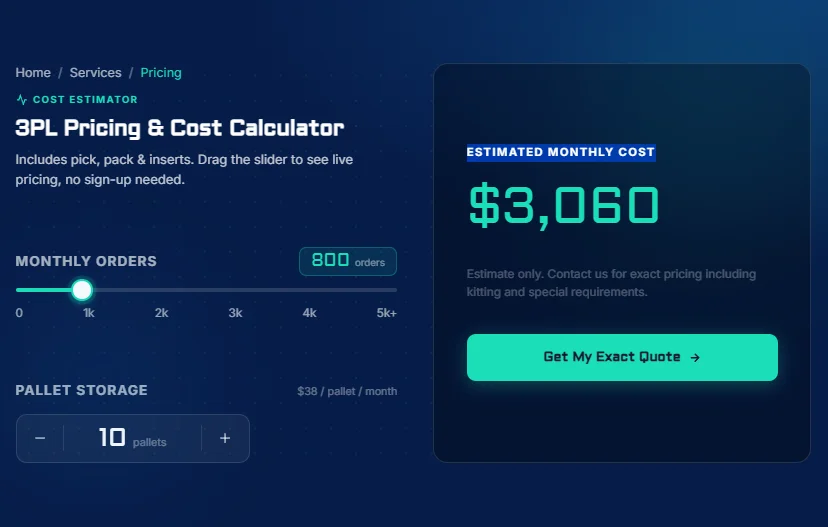
Take a skincare brand doing 800 orders a month, holding 10 pallets of stock, shipping mostly 500g satchels, with one inbound delivery of 2 pallets a month.
| Line | How it’s worked out |
|---|---|
| Pick and pack | 800 orders × the per-order rate for that volume tier |
| Storage | 10 pallets × the per-pallet monthly rate |
| Postage | 800 satchels × the 500g carrier rate to each destination |
| Receiving | 2 pallets × the per-pallet receiving rate |
| Packaging | 800 satchels, plus any inserts |
| Extras | Nil, unless returns or kitting come up |
Our calculator puts the first two lines for this brand at about $3,060 a month. Postage, receiving and any extras go on top.
What usually surprises people when the numbers go in: postage is often the largest line, bigger than pick and pack. The fulfilment fee itself is small next to the margin on the product, so the real conversation is about whether the stock is moving, not the rate.
Put your own orders and pallets into the calculator to see the same two lines for your business.
Hidden fees to ask about
Most of these aren’t hidden on purpose. They’re just not in the headline rate. Ask about each one before you compare quotes.
- Minimum monthly spend or volume commitment. Most 3PLs have one in some form. Ask what happens in a quiet month.
- Setup, integration or onboarding fees. Connecting your store and loading your SKUs. Some charge, some don’t, so ask.
- Account management or technology fees. A flat monthly charge for the platform or your contact.
- Postage markups. Passed through at the 3PL’s carrier rate, or with a margin added? Ask for both figures.
- Long-term or overage storage. Extra charges for stock that sits past a set period, or for going over an agreed pallet count.
- Peak-season surcharges. Higher per-order rates or a labour surcharge in November and December.
- Returns processing. Per-return fees, and whether restocking and disposal are separate.
- Exit terms. Notice period, and what it costs to get your stock out if you leave.
The simplest test is to ask for a sample invoice for a brand like yours. If a 3PL can’t show you one, that tells you something too.
Our pricing: no minimum spend
Fulfilpackers has no minimum monthly spend, no minimum order quantity and no lock-in contract. Every invoice is itemised across storage, fulfilment and shipping, with shipping at our carrier rates to anywhere in Australia.
We suit brands with a steady flow of orders. If you send only a few parcels a week, packing them yourself is usually still cheaper. Above 5,000 orders a month we build a bespoke rate card.
The four numbers a 3PL needs to quote you
Any 3PL will ask for the same things, so have them ready:
- Monthly orders. Your average over the last few months, and your peak month.
- Storage. How many pallets your stock takes up (or cubic metres if it’s never been palletised).
- SKU count. Active SKUs, not everything you’ve ever listed.
- Average parcel size and weight. Satchel or carton, and the typical weight. This drives postage.
Our calculator runs on the first two. For an itemised quote we’ll ask for the other two plus anything unusual: fragile goods, kitting, expiry tracking, B2B orders alongside retail.
Is a 3PL cheaper than doing it yourself?
Often, not always. A 3PL turns fixed costs into variable ones: instead of a lease, a packer, shelving and a stack of satchels, you pay per order and per pallet, and the cost moves with your sales. You also get carrier rates a single brand can’t negotiate, which can cover a good share of the fulfilment fee on its own.
Where it doesn’t stack up: low order volumes, very heavy or awkward products, or a business that already pays for the space and the people. Compare your fully loaded cost per order (rent, wages, packaging, postage, your time) against the 3PL’s per-order total including postage.
If you’re near the line, read the signs you’ve outgrown self-fulfilment and how to review 3PL contract terms. Our 3PL fulfilment page covers what’s included when you ship with us.
FAQ
What are 3PL fees?
The charges for each part of the job: receiving your stock, storing it, picking and packing each order, packaging, and postage. Some 3PLs add account, technology or returns fees. See what’s on a 3PL invoice for each one.
What does it cost to run your own warehouse?
Rent, power, wages, insurance, racking and equipment, a warehouse system, packaging and postage at the rates a single brand can get. Most of those are fixed, so you pay them in a quiet month too. Add your own time packing orders, and compare the total per order against a 3PL quote.
How much does a 3PL cost per order in Australia?
There’s no published industry figure. The per-order rate depends on your monthly volume, items per order and handling, and it’s quoted on top of postage. Put your numbers into a 3PL cost calculator or ask two or three providers for a sample invoice.
Do 3PLs charge for shipping on top of fulfilment?
Yes. Pick and pack covers the work; postage is a separate line, charged per parcel by size, weight and destination. Ask whether it’s passed through at the 3PL’s carrier rate or marked up.
Is there a minimum to use a 3PL?
Most have a minimum monthly spend or order volume. Fulfilpackers has neither, and no lock-in contract.
Is storage charged per pallet or per item?
In our experience, per pallet per month is standard in Australia. Some 3PLs charge per bin or shelf for small, fast-moving items. Either way, holding less stock is the quickest way to bring the bill down.
What should I compare between 3PL quotes?
Price is only part of it. Ask each 3PL for a sample invoice for a brand like yours, then compare their pick accuracy and dispatch cut-off, whether their system connects to your store platform, where they ship from, their minimum spend and their notice period. A cheaper rate with a late cut-off or a long lock-in can cost more in the end.
What is cost-plus pricing?
The 3PL charges you what the work actually costs them (labour, space, materials) plus an agreed markup. It’s transparent, but harder to budget than per-activity pricing because the costs underneath can move. Ask how the markup is set and how often the underlying costs are reviewed.
Ready for a number? Use the 3PL pricing calculator, then send us your four figures for an itemised quote.